Allen Hu

Allen Hu

Assistant Professor of Finance
UBC Sauder School of Business

Email: allen.hu@sauder.ubc.ca

Research Interests:
Big Data and AI in Finance
Information in Financial Markets
Entrepreneurial Finance and Behavioral Finance

Publications

Persuading Investors: A Video-Based Study
with Song Ma

Journal of Finance, 2025

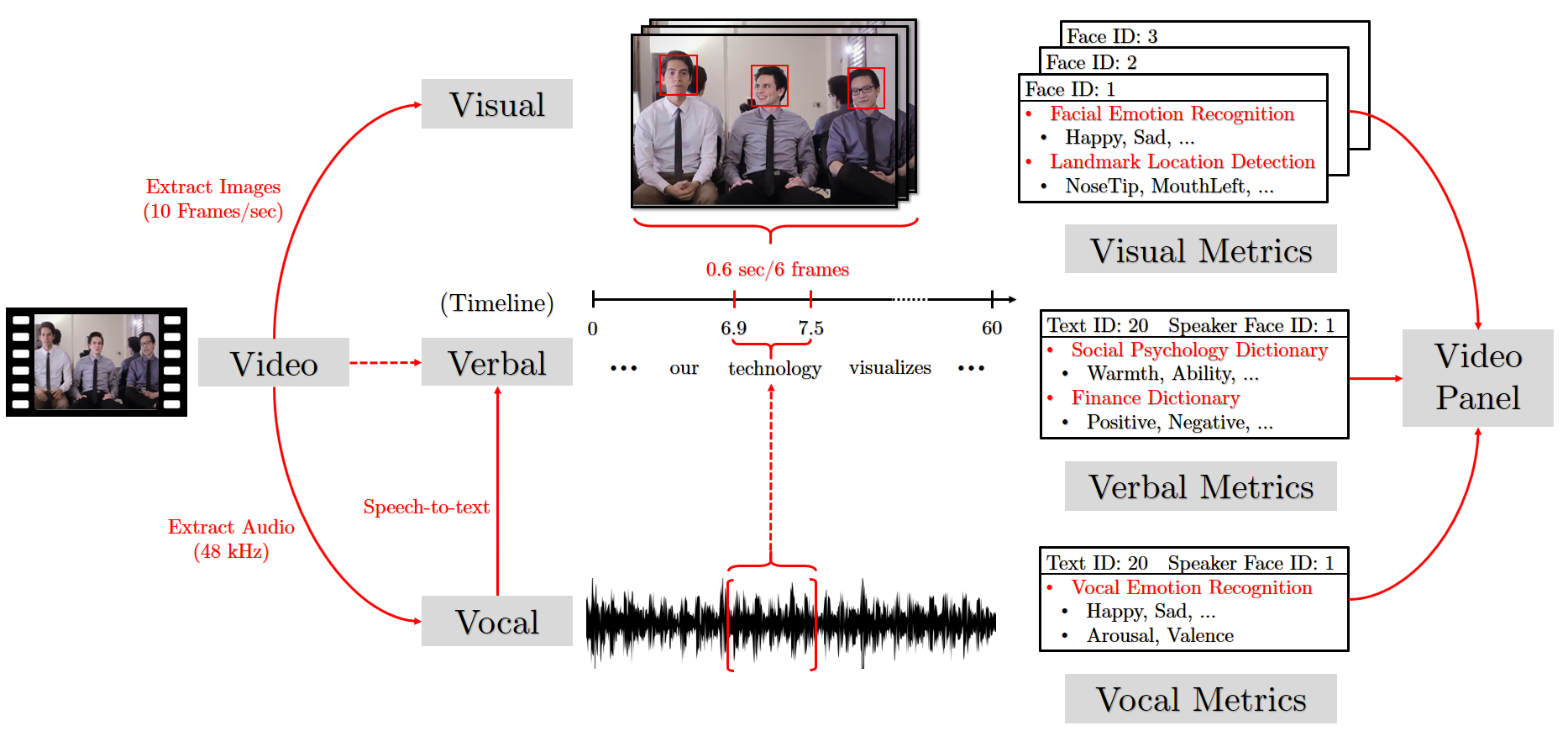
Persuasive communication functions through not only content but also delivery, i.e., facial expression, tone of voice, and diction. This paper examines the persuasiveness of delivery in startup pitches. Using machine learning algorithms to process full pitch videos, we quantify persuasion in visual, vocal, and verbal dimensions. We find that positive (i.e., passionate, warm) pitches increase funding probability. Yet conditional on funding, startups with higher levels of pitch positivity underperform. Women are more heavily judged on delivery when evaluated in single-gender teams, but they are neglected when co-pitching in mixed-gender teams. Using an experiment, we show that persuasion delivery works mainly through leading investors to form inaccurate beliefs. Persuading Investors abstract figure

Asset Complexity and the Return Gap

with Pengjie Gao, Peter Kelly, Cameron Peng, and Ning Zhu

Review of Finance, 2024

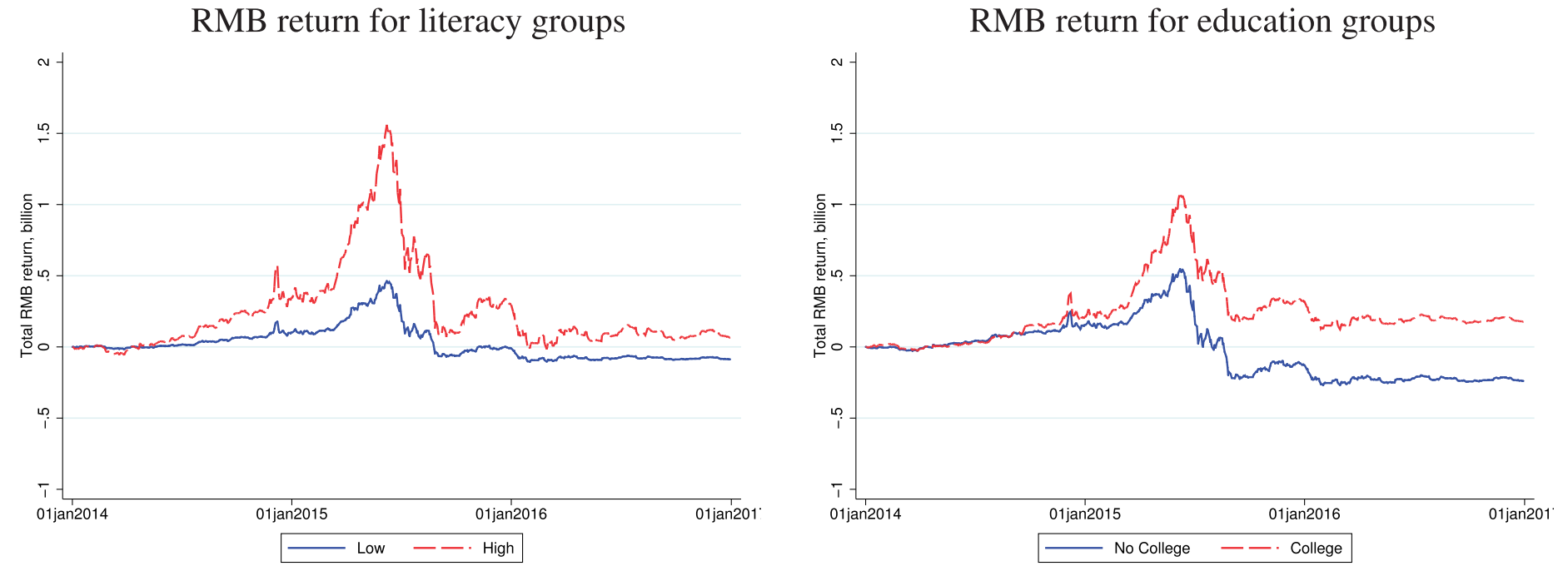
Existing research finds that investors' returns vary with their wealth and level of sophistication. We bring a new perspective from the supply side by showing that return heterogeneity can be magnified as assets offered by the market become more complex. Using detailed account-level data, we examine the trading of B funds—complex, structured products in the Chinese market. During a three-year market cycle, the return gap between the naive and sophisticated is an order-of-magnitude greater when trading B funds than when trading simple, non-structured funds. In an event study, we confirm that this disparity is driven by differences in investors' understanding of product complexity. Asset Complexity and the Return Gap abstract figure

Working Papers

Financial News Production

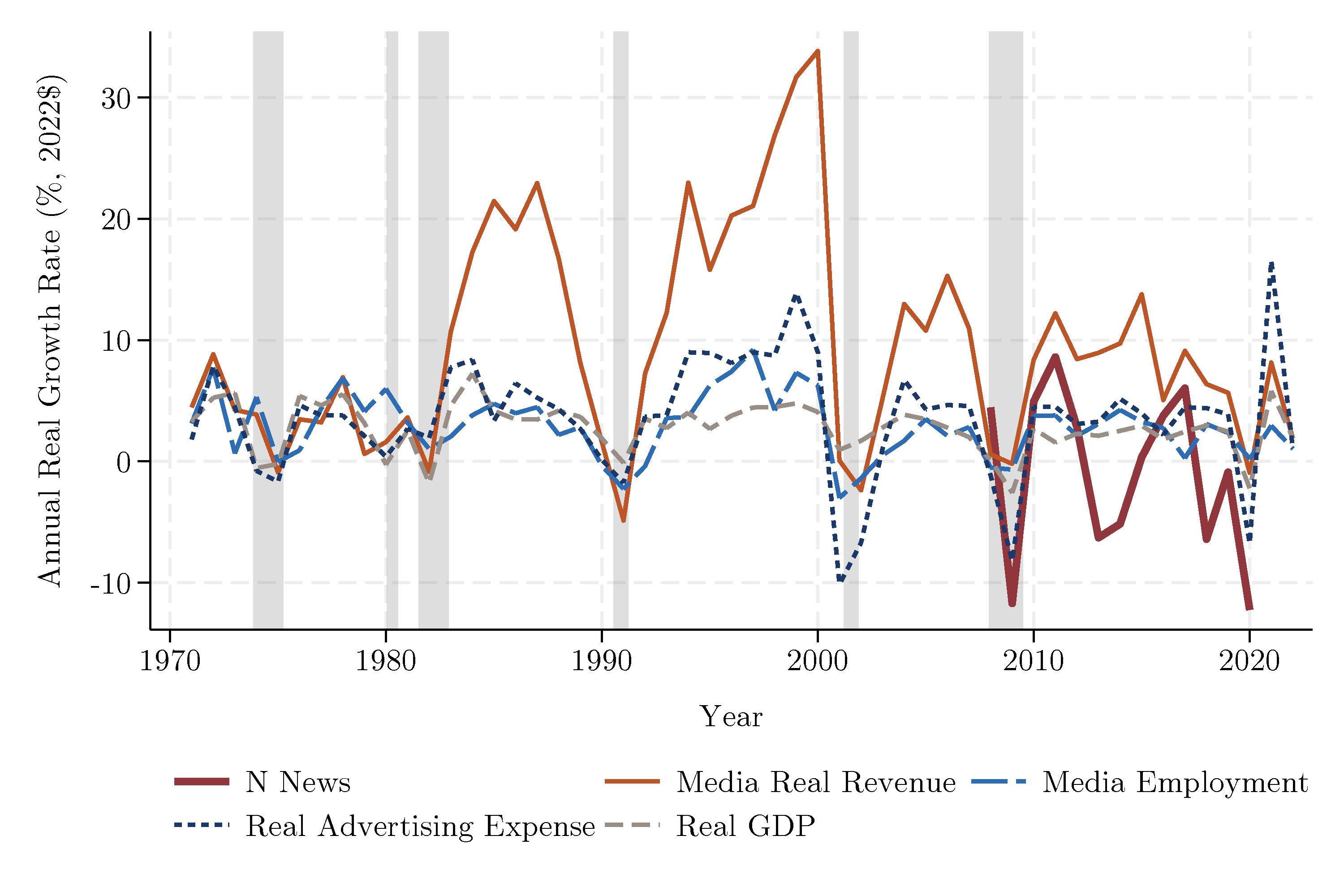
I establish that financial news production can be strongly influenced by factors unrelated to the arrival of, and demand for, information. Fluctuations in real economic activity, such as advertising, generate cash-flow shocks to the media sector, which reacts by changing news quantity and quality. Such endogenous dynamics in news production then shift the levels of uncertainty and information asymmetry about firms, affecting real and financial outcomes. Implementing a within-firm estimator on a comprehensive data set of media advertising revenue, news, and job postings, I compare news production about the same firm by different news media whose advertising revenues are differentially exposed to industry-level advertisement shocks. Financial news production is procyclical at the aggregate level and serves as a channel for economic shock transmission and amplification. Financial News Production abstract figure

How Do Banks Compete? Evidence from Advertising Videos

with Xugan Chen and Song Ma

This paper studies how banks compete through a novel lens: the content of banks' advertising videos. By analyzing TV advertisements using video embeddings, we identify three primary competitive dimensions: pricing advantages, service quality, and trust-building emotional appeals. Banks with high local market shares compete on service and trust while downplaying pricing. New entrants primarily compete on pricing for new customers. Banks lacking pricing or service advantages lean on emotional appeals. Advertising strengthens the deposit franchise: non-pricing brand capital enables banks to maintain wider spreads during monetary tightening, thereby shaping the transmission of monetary policy. How Do Banks Compete? Evidence from Advertising Videos abstract figure

Inelastic Demand at the Extensive and Intensive Margins
with Xindi He and Zigang Li

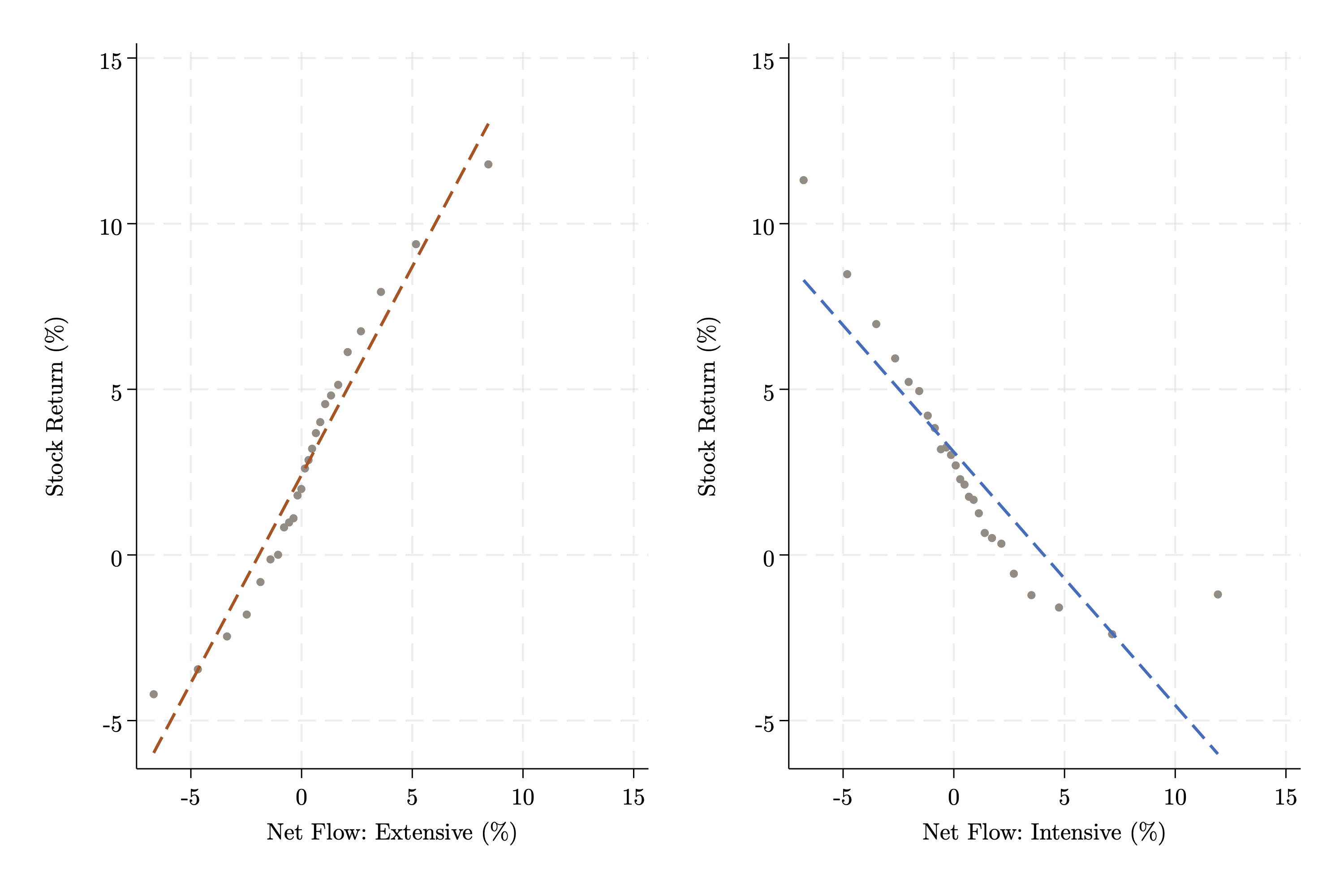
We decompose investor demand into its extensive margin—initiating or liquidating a position—and intensive margin—scaling an existing position. The extensive demand is economically large, accounting for 40% of institutional and 80% of retail flows, and its estimated price elasticity is closer to zero, and often positive. Extensive demand is primarily driven by past returns and attention, whereas intensive demand reflects fundamentals. To account for these findings, we develop a Grossman-Stiglitz-style model of inelastic markets where extensive flows are unobservable endogenous demand shocks, and investors learn from prices based on their subjective expectations about these flows. Learning from prices leads to a more inelastic, and even upward-sloping, extensive demand curve. Embedding the model in an asset demand system, we structurally estimate both elasticities under alternative specifications of flow expectations. In a counterfactual of reallocating capital from intensive to extensive demand, prices, volatility, and firm-specific price informativeness increase, while market-wide informativeness declines. Inelastic Demand at the Extensive and Intensive Margins abstract figure

Information Acquisition and the Finance-Uncertainty Trap
with Ding Dong, Zhaorui Li, and Zheng Liu

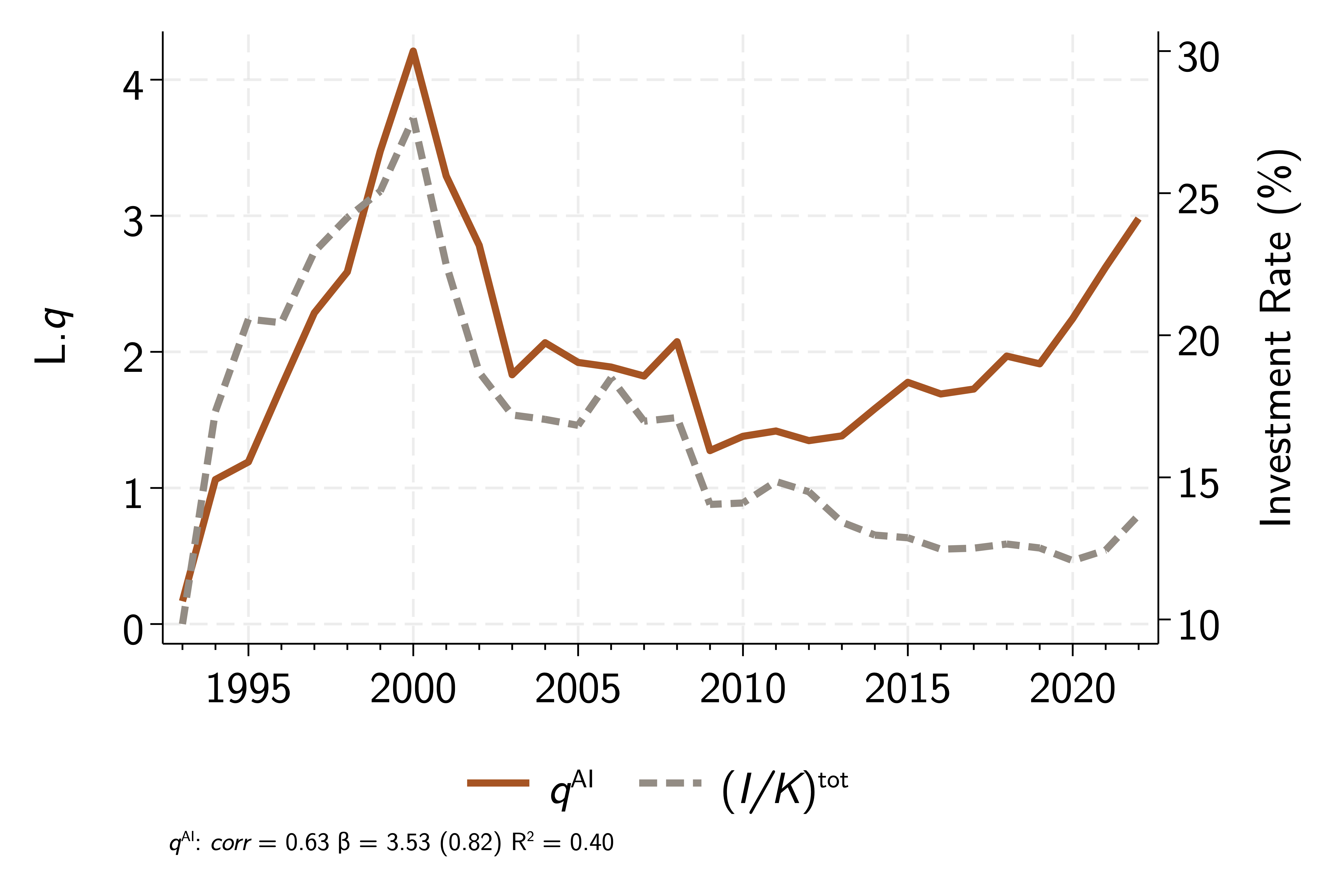
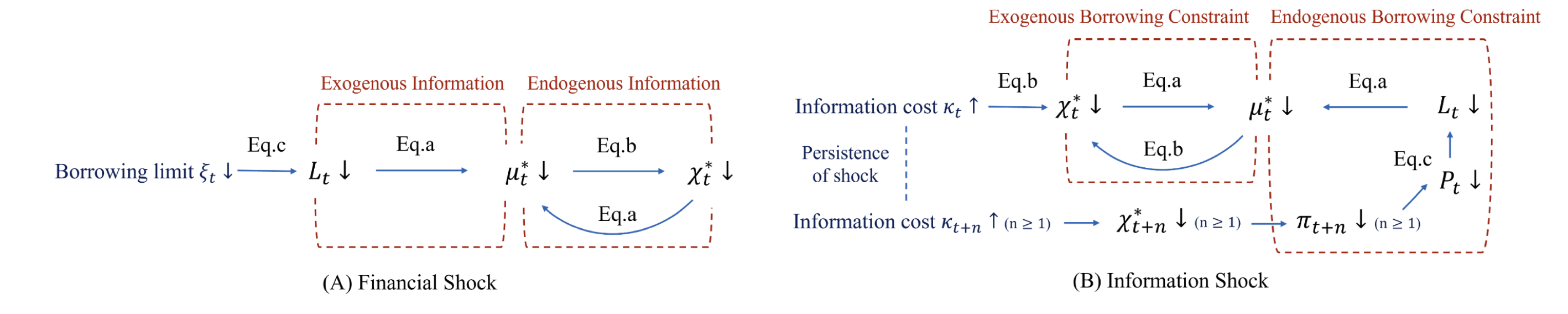
Using novel measures of information acquisition, we document causal evidence of a feedback loop between firms' credit access and information acquisition. To examine the macroeconomic implications of this feedback loop, we develop a tractable general equilibrium framework with financial frictions and endogenous information acquisition. In line with the empirical evidence, the model predicts that a rise in information costs raises the level of uncertainty and reduces a firm's equity value, hampering its credit access. On the other hand, tightened credit constraints restrain activity of high-productivity firms, leading to misallocation that reduces aggregate productivity and firm profits, and discouraging information acquisition. This feedback loop creates a finance-uncertainty trap that substantially amplifies and prolongs business cycle fluctuations. Information Acquisition and the Finance-Uncertainty Trap abstract figure

Inference with Cluster Imbalance: The Case of State Corporate Laws

with Holger Spamann

Reject & Resubmit at Review of Financial Studies
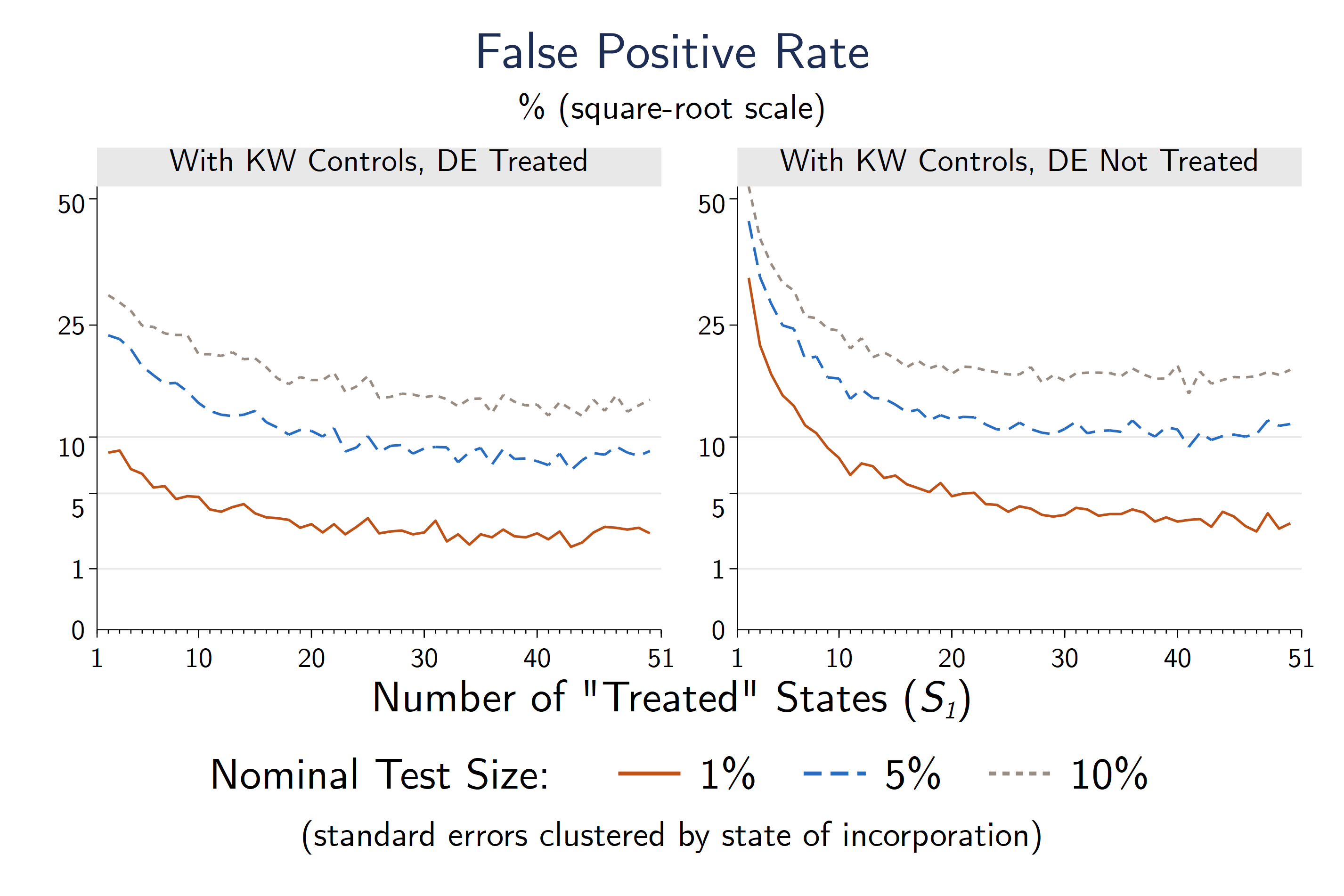
A workhorse research design identifies the effects of corporate governance by changes in state laws, clustering standard errors by state of incorporation. Asymptotic inference using these standard errors, however, dramatically understates false positives: in a typical specification, randomly generated placebo laws have 1/5/10%-level significant estimated treatment effects 9/21/30% of the time. This poor finite sample performance is due to unequal cluster sizes, especially Delaware's concentration of half of all incorporations. Bootstrap or permutation tests mostly fix the problem, common robustness checks less so. The placebo law approach can also be used to calculate power, which will be acceptably high only for substantial effect sizes. Inference with Cluster Imbalance: The Case of State Corporate Laws abstract figure

Work in Progress

Contact

Email:
allen.hu@sauder.ubc.ca
Phone:
+1 (604) 827-1609
Office:
862 Henry Angus Building
Address:
2053 Main Mall, Vancouver, BC, Canada V6T 1Z2

About

Allen Hu is an Assistant Professor of Finance at Sauder School of Business, the University of British Columbia. Prior to joining UBC, he obtained his Ph.D. in Financial Economics from Yale School of Management in 2024 and his B.E. in Industrial Engineering from Tsinghua University in 2017. His primary research areas are big data and AI in finance, information in financial markets, entrepreneurial finance, and behavioral finance.

Links

Curriculum Vitae (PDF)
UBC Sauder Faculty Page
Google Scholar
SSRN
LinkedIn